
A POWERFUL SCREENPLAY OFFERS A UNIQUE READING EXPERIENCE

Jack Gillis (William Holden) at Norma Desmond (Gloria Swanson) Mansion
That Old Black Magic
_____________________________
Sunset Boulevard is the setting for one of the great films of all time. The supposed setting of the great film Sunset Boulevard is in this exclusive part of Sunset – like the film – called Sunset Boulevard. Director Billy Wilder wants to make it clear to the audience by images at the very first part of the film. In actuality, the home they used as location for the film was at the intersection of Wilshire and Crenshaw.
But the location of Sunset Boulevard is important to the image that WIlder wants to project to the world. With the co-author of the screenplay Charles Brackett really being the genius behind this screenplay. Brackett was a sophisticated and well educated (Harvard) writer for the New Yorker. He was just what the new immigrant to America Billy Wilder needed as a partner. Wilder learned much from reading the comics. Brackett added a sophistication to the dramatic instincts of Wilder. It was an important but sometimes difficult collaboration.

LA 1949
Today, I re-read the original screenplay for Sunset Boulevard. And found it to be more Incredible than the first time I read it. The movie is one of my favorite. Perhaps somewhat because I grew up a few blocks above Sunset Strip.
The version of the Sunset Boulevard screenplay I read today was the original studio version from the Paramount Stenography Department. One of the most intense reading experiences I’ve had. In part, I think reading this screenplay allows one to participate in the final creation of some final vision. It does this by suggesting scenes with the few words of a scene description. In a novel, there would be many more words defining the scene, making it less reader participatory, and more of a “hot” non-participatory media.
Perhaps too it is the experience of reading something in a condensed amount of time. In effect, going through a dramatic story within the space of a certain mood of the reader or audience. One maintains a mood or feeling for the work much more than they could do over the many hours to read a novel. Here, a period of 90 minutes to get the structure for a dramatic story. A structure that suggests but does not define.
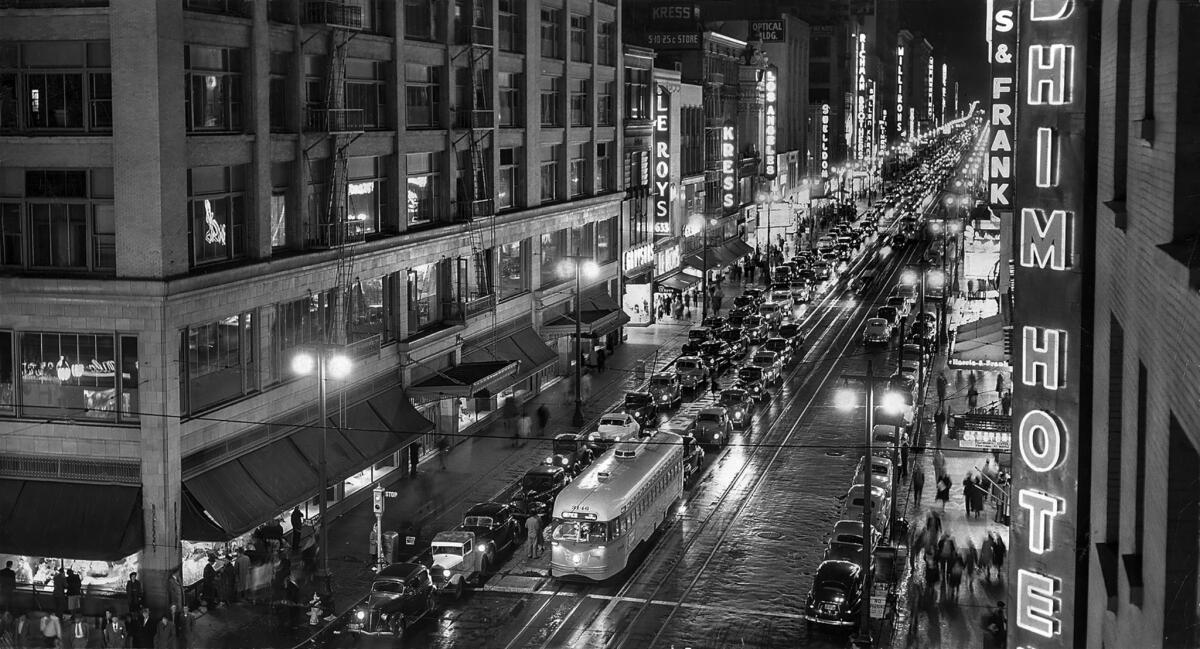
Broadway / Downtown LA in the 40s
The structure is divided into Sequences rather than Acts. Wider and Brackett did not speak the language of modern screenwriting theory. Yet the drama and character development is better than anything I have ever read. Especially in just 125 pages.
Marshall McLuhan would describe the screenplay as “cool” or participatory media as McLuhan picked up a quote from Sir Francis Bacon in his Understanting Media of the 60s. Perhaps this is really the power of reading the screenplay for Sunset Boulevard in its original form, published by the University of California Press. With an excellent introduction by Jeffrey Meyers. Do not get this on Kindle! This defeats the whole purpose of you reading a copy of the original screenplay for Sunset Boulevard.
What is it about the reading experience of this screenplay in its original form? The proper time length of a mood or feeling or cycle to move in life? As I read the screenplay for Sunset Boulevard, I read it the best way possible: in the original medium of type it appeared in. It looks to be courier and has mis-spellings and all. Interestngly though, reading the original studio copy, is fascinating and a powerful experience for a reader wanting to see the development of drama. On the title cover of the screenplay is stamped in the bottom right of the title page “Received from Stenographic Dept, March 21, 1949. Paramount Pictures Inc.”
* * *
I learned today a screenplay might possess a powerful spirit. So that one can really get to know the characters of the sceenplay when they come alive for the reader.
Especially, when read in its original media form rather than homogenized through electronic manipulations of the original. One needs to read the original Stenographic Department script from the link above.
In some ways, the overall context of all of this might be expressed in the number of words used in the screenplay Sunset Boulevard and a typical thriller novel today. In the end, is giving the audience more or less information the best method for powerful communication with the audience?
* * *
For example, a feature screenplay contains about 100-110 pages or roughly 25 – 30,000 words. Compared to a screenplay, an average thriller novel contains 80 – 100,000 words.
Screenplays always are less words than novels because they are meant to invite participation while novels are meant to define more than invite. Screenplays a cool media and novels more of a hot media. A question about the importance of reader/audience participation in the story being told.
The best screenplays invite and passionately reinforce the participation of others. Novels only invite participation of the reader. Perhaps some film or other producer who wants to translate it to another media.

Griffith Obsrvatory / Overlooing LA
The screenplay for Sunset Boulevard is cool – suggestive – rather than hot – or definitive. In this atmosphere, the characters take on the life you, the reader, give them. It was an amazing experience to read the screenplay today.
And, amazing to me, created in 1949, long before all our sophistiated screenwriting theories today. The scenes so excellent in framing the context of the content of the film’s messages. The characters so real. Their actions understandable. We can see the relationship develop. It makes sense in a crazy way.

The Famus Final Scene of Sunset Boulevard